When it comes to tropical fruits, mangoes and papayas often steal the spotlight. Their vibrant colours and delicious flavours make them popular choices, but these fruits are more than just tasty treats, they offer a range of nutritional benefits that can contribute significantly to your family’s diet.
But which one is better for you mango vs papaya? and do they differ in nutritional value? Let’s dive in.
How do mangos grow?
Mango trees (Mangifera indica) are native to tropical climate of southern Asia and southeast Asia. However they can also be found in other tropical environments like Brazil, the West Indies, and Florida.
India is currently the world’s largest producer of mangoes, followed by China, Thailand, Mexico, and Indonesia. This gives us many options when it comes to mango production.
Mango trees can be grown successfully in cooler climates, in a conservatory or greenhouse. They do need plenty of warmth, sunshine and protection from frost. So you could technically grow mangoes in your own home!
Mangoes belong to genus Mangifera which consists of about 30 species of tropical fruiting trees in the flowering plant family Anacardiaceae.
How do you know if you are allergic to mangos?
You can have an allergic reaction to mango but mango allergies are relatively rare compared to other food allergies.
Mangoes are part of the cashew family, which includes poison ivy and poison oak. They have also been limked with apple, peach and pear due to cross reactivity. This can mean that those who have a cashew nut, apple, pear or peach allergy may also react to mango.
I would always advise in this case to try mango with caution. Mangos also contain something called urushiol, an oil that can cause skin reactions in some people.
Mango; The Luscious Nutritional Superhero
Mangoes are often hailed as nutritional heroes, they are so good, I’m surprised they don’t come wearing a superhero cape!
These sweet, tropical fruits with that distinctive yellow/orange flesh are packed with more than 20 vitamins and minerals. This makes them fantastic for your heart, skin, eyes, digestive, and immune system.
What are the benefits of eating mango?
- Vitamins and Minerals: Ripe Mangoes are rich in fat soluble vitamin A and K. One cup of sliced mango also provides nearly 70% of the recommended daily intake of vitamin C, which helps with iron absorption, protects cells from damage, and supports your family’s immune system.
- Low-Calorie and High-Fibre: Mangoes are low in calories (62 calories per 100g) and high in fibre, which is amazingly beneficial for your families gut health and helping to reduce the risk of constipation.
- Antioxidants: Mangoes contain several antioxidant compounds that help protect against damage from free radicals, which can help with immune support.
How to serve mango to a baby
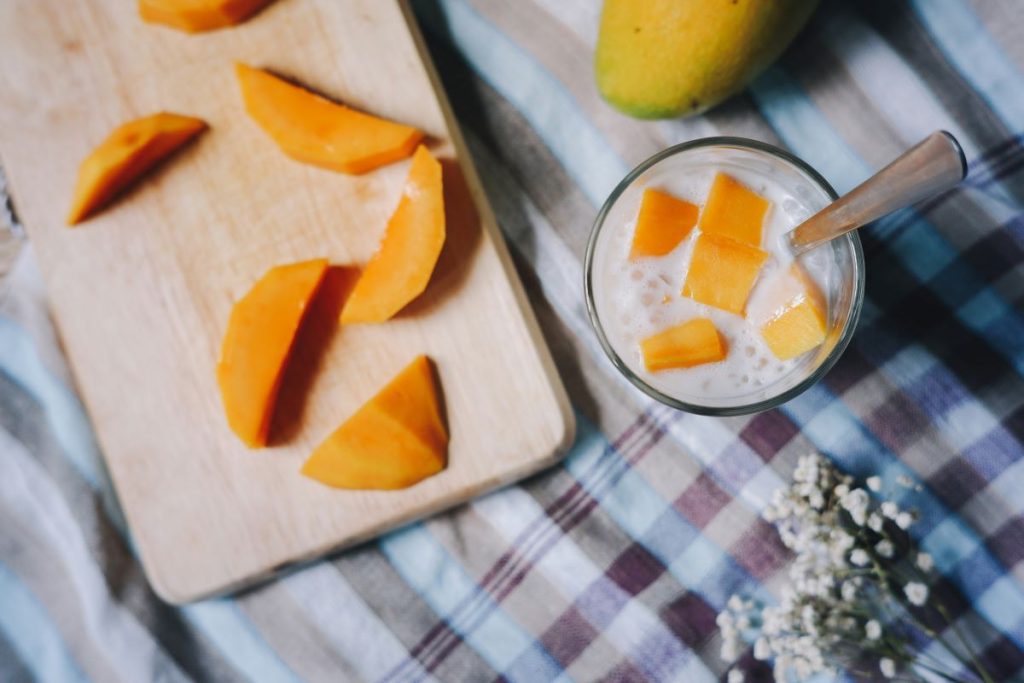
Mangos can be enjoyed on their own, added to breakfast pancakes in place of plant based milk, blended into smoothies, or used in a tasty mango salsa. Combining mango with vegetables such as butternut squash to add to get your little ones taste buds going.
Can babies eat mango?
Mango can be given to your baby from when they start weaning at 6 months old. It is recommended that for 6 months old, you serve minced mango on top of spoon fed foods such as porridge or baby rice.
You can also offer your little one mango fingers – but, make sure the mango is ripe enough that it mashes easily when pressed gently between your thumb and fingers. There is a little caveat to this. Mango can be a little slippy and can be a choking hazard due to their fibrous texture. Just make sure you are always with your baby when they are trying this new food.
From 12 months old you can serve diced ripe mango as finger food as well as a fork to encourage your little one to eat with utensils.
Can I eat raw mango?
I wouldn’t advise to eat raw mango. It can be a little tough on your digestion. Definitely don’t give them to your little ones as it could cause loose stools and tummy pains.
Now let’s compare mango to papaya. First…
How do papayas grow?
Papaya belongs to the family Caricaceae. They originate from Central America, and are now grown in all tropical countries and many subtropical regions of the world.
Papayas are dioecious plants – this means that a plant bears either exclusively male or female flowers. As a result, successful fertilisation requires two papaya plants of opposite sexes, interesting hey!
10 to 14 months after fertilisation, the first flowers emerge and soon thereafter, the tree shows its first fruits.
How to grow papaya from seed
Most papayas are grown from seed. The seeds are extracted from fully ripe fruit, washed to remove gelatinous material and several seeds are planted per pot of soil.
As papayas are originally from tropical climates, they can only thrive in cooler climates if they are first started indoors and then later placed in a pot in a conservatory or greenhouse or on a balcony or terrace in summer. This means unlike mangos your very unlikely to be able to grow them from home.
Papaya; The Nutrient-Rich Powerhouse
Papayas might not always be as a popular fruit as mangos, but they are just as impressive in their own right.
Often considered one of the most nutritious fruits, fresh papaya is packed with essential vitamins and minerals.
Its smooth texture also makes it very different to the well known fibrous texture of the mango.

Papaya Nutritional Value
- Vitamins and Minerals: Papaya is rich in vitamin C (over 50% more than mango), vitamin A (beta carotene), potassium, fibre, calcium, thiamin and riboflavin (both from the vitamin b family)
- Digestive Health: The high vitamin C and A (fat-soluble vitamin) content in papaya can help with digestion. Papayas contain papain and chymopapain. These two compounds (enzymes) help in breaking down proteins from the food we eat and can help to improve digestion.
- Medicinal Benefits: Studies suggest that papayas may have anticancer properties, reduce inflammation, and reduce the risk of heart attacks (one for the adults here)
- Sugar content; papaya contains less sugar than mango
The difference between green and red papaya
Sometimes it is thought that green and red papaya are different varieties but this is not the case. The different colours are due to the ripening stages of the fruit.
A green papaya skin indicates this papaya is less ripe than one with a orange/red skin. The flesh of the papaya will also change with less ripe papayas being white and ripened flesh being orange.
Best Ways to Eat Papaya
Papaya can be cooked like squash when it is still young, firm, and green.
They are such a versatile ingredients and can be eaten fresh, added to fruit salads, or blended into smoothies much like mango. Their creamy texture and slightly sweet taste (less sweet than mangoes) make them a unique addition to various dishes.
You can freeze papaya spears on a stick for popiciles for your little one.
Dried papaya can be added to pilau rice and some people even pair papaya strips rolled in ham as a little snack for their toddlers.
When can babies eat papaya?
Much like mango babies can eat papaya from 6 months old. Never give your baby unripe fruit as it can be a little harsh on their digestion. Always make sure it is soft and has that beautiful orange/red colour before serving.
From 12 months you can serve papaya in cubes as small finger foods.
Papaya Allergy
Papaya is not a common allergen, although if you have a latex allergy you may also be sensitive to papaya due to its similar structure. There has also been found to be although rare an allergy to papin which is an enzyme in papaya.
Ripeness Test Mango vs Papaya; The difference in these fruits.
Never judge a mango by its colour alone, because the red colour doesn’t mean that it’s ripe. The best way to tell is to gently squeeze the mango. It should not be hard, but give slightly like a ripe avocado or a peach would. You can also smell the mango near its stem and if it’s ripe, you’ll notice the sweet smell with a tropical twist.
The skin of an unripe papaya is green, but as it ripens it will change colour to yellow or orange-gold, depending on the variety. The papaya should be almost fully yellow or orange. You can also do the squeeze test, by gently pressing the papaya, and it should give a little. A ripe papaya will have a sweet and rich aroma.
Trust me, there is are notable differences between the ripe and unripe fruit so you will know much like underripe bananas.
How to store mango and papaya
Top tip – do not refrigerate unripe papayas or mangos as they will take forever to ripen – however, once they are ripe, you can refrigerate them for 4 to 5 days.
To speed up the ripening process, you can store both papayas and mangos in a paper bag at room temperature as the natural ethylene gas they release will help them ripen much faster.
How to prepare mango for your baby
You have checked the mango is ripe and you’re good to go. You try to prepare some really nice sliced mangoes for your family and no, it ends up as a pile of mush due to that huge hard seed in the centre. Sound familiar?
So, what can help? Have you also heard of the mango peeling hack using a drinking glass to slice off the cheeks.
Many social media videos show users taking a thin rimmed glass and gently pressing the mango down the side removing the skin from the flesh. Looks easy… but, to me it also looks dangerous… nothing worse than smashed glass!
I think I’ll stick with an old faithful technique.
Click the button below for a great link to help you slice your mango.
How to prepare a papaya
Papayas, are completely different and very easy to prepare. All you need to do is cut the papaya in half lengthwise, scoop out the seeds, and remove the skin.
Mango and Papaya recipe for toddlers.
These two fruits don’t have to face off against each other, they can work really well today. Check out the recipe below.
Homemade papaya, mango and yogurt popsicles.
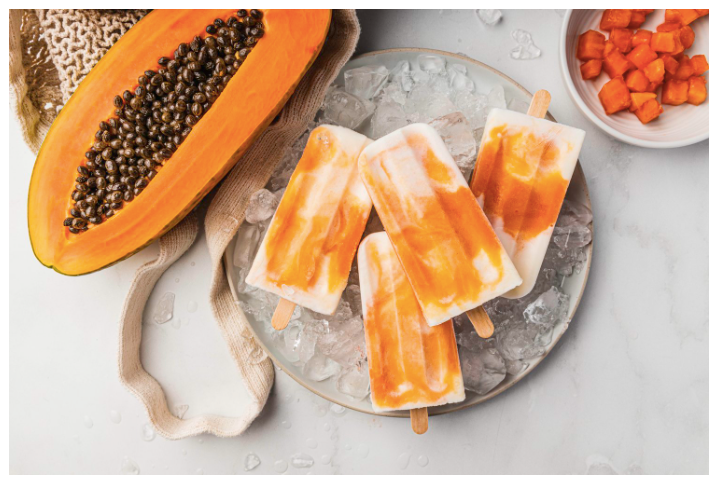
Why not try these gorgeous Papaya popsicles – recipe kindly shared and adapted from Eats With Marie –
Ingredients
- ¼ cup warm water
- ½ cup caster sugar* (or sweetener or choice), divided into 2 batches
- 1 cup (290g) unsweetened plant based yogurt – make sure it has added calcium.
- 100g mango**, roughly chopped
- 300g Papaya, roughly chopped
*Tip – you can remove the sugar and use a sweetened yogurt*
How to
1. Combine the water and ¼ cup caster sugar in a medium mixing bowl, until the sugar has dissolved. Add the yoghurt and whisk to combine. Set aside.
2. Place the mango, papaya and remaining sugar in a blender and blend until smooth.
3. Fill the popsicles moulds ⅓ of the way with the yoghurt mixture, then top with papaya mixture and then another small layer of the yoghurt mixture. Add a popsicle stick to each mould, using the stick to gently swirl the layers together. Freeze for 2–3 hours or until frozen.
4. To serve, run each mould under warm water for 10 seconds to loosen.
** Notes – If fresh mangoes are not available, frozen thawed mango may be used.
Mango vs Papaya; What’s the difference – a final face off.
Shape and Appearance:
- Mangoes: Smaller, with red, green, and yellow skin, and a single large, flat seed in the centre.
- Papayas: Larger, squash-shaped with bright yellow-green skin, vibrant orange flesh, and lots of black seeds in the centre.
Taste:
- Mangoes: Sweet flavour
- Papayas: Creamy, slightly sweet flesh often described as a cross between cantaloupe melon and mango.
Nutritional Comparison:
- Mangoes: Richer in folate, vitamin A, and K.
- Papayas: Higher in vitamin C and lower in sugar,
- Both are a great source of dietary fiber.
Conclusion: Which Should You Choose?
Both mangoes and papayas are excellent additions to a healthy diet this summer season each offering unique benefits. If you’re looking for a fruit with high vitamin K and A content and a deliciously sweet flavour, mangoes are your go-to. On the other hand, if you need a boost in vitamin C and a fruit that aids in digestion, papayas are the perfect choice.
Honestly, it is completely personal preference to me it is a mango every time due to their sweet flavour, saying that I have had papaya in breakfast cereal and it was delicious!
Why not enjoy both? Incorporating a variety of fruits into your families diet ensuring you get a broad spectrum of nutrients. So, next time you’re at the store, pick up some mangoes and papayas and enjoy the best of both worlds.

Hannah is an Expert Registered Dietitian specialising in Vegan Family Nutrition and Cows Milk Protein Allergy.
She is a respected figure in the field of nutrition and a captivating speaker and sought after media spokesperson being featured in esteemed publications including the Sunday Times, Independent and Huffington Post.
Credentials
Registered Dietitian
First Class Degree in Nutrition
Experience
Over 15 years experience working in the field of nutrition
Respected Media Spokesperson both in the UK & USA; quoted online, TV and in local and international news
Writer & Researcher, supporting the BDA and PEN Nutrition