
If your baby is bringing up milk, arching their back, crying during feeds or seems uncomfortable after eating, it is very easy to start wondering:
“Is this reflux — or could it be milk allergy?”
I get asked this a lot.
The tricky bit is that reflux and cow’s milk protein allergy can look very similar in babies.
Reflux is incredibly common. In the UK ‘visible regurgitation’ affects at least 40% of babies and usually improves as they get older. Around 90% of affected babies have grown out of it before their first birthday.
Cow’s milk protein allergy, or CMPA, can also cause reflux-type symptoms, particularly in delayed, non-IgE cow’s milk allergy.
So reflux does not automatically mean CMPA.
But if it is happening alongside other symptoms, or your baby is really struggling, it can be worth looking at the bigger picture.
That is what I am going to help you do in this article.
What is normal reflux in babies?
Reflux happens when some of the contents of your baby’s stomach travel back up into their food pipe or oesophagus.
For many babies, this simply looks like milk coming back up after a feed, usually called posseting.
It usually happens because the muscle at the bottom of the oesophagus is still developing. As your baby gets older, that muscle becomes stronger and reflux normally improves.
A baby with straightforward reflux may:
- Bring up small amounts of milk after feeds
- Hiccup or cough during feeds
- Swallow or gulp after feeding
- Seem a little unsettled around feeds
But importantly, many babies with reflux are otherwise perfectly well, feed happily and continue to gain weight.
If that sounds like your baby, CMPA would not be the first conclusion I would jump to.
Can CMPA cause reflux?
Yes. Reflux can be one of the symptoms seen in babies with cow’s milk protein allergy.
UK guidelines say that gastro-oesophageal reflux disease amongst the possible gastrointestinal symptoms of delayed, non-IgE food allergy. It also notes that some symptoms of non-IgE cow’s milk protein allergy can look very similar to reflux.
But this is the important bit:
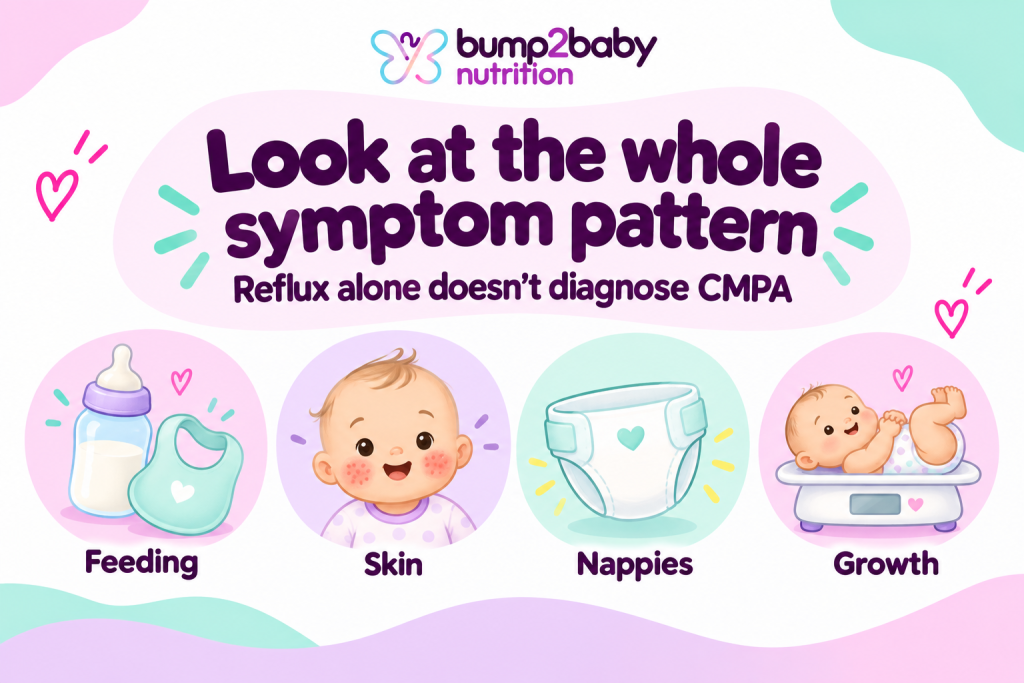
Reflux on its own does not diagnose CMPA.
If you have a look at my blog on CMPA symptoms you will see there are a lot of other symptoms that can be related to milk allergy.
So when a parent tells me:
“My baby has really bad reflux. Do you think it is milk allergy?”
I would never decide from the reflux alone.
I would want to know what else is happening.
CMPA or reflux: what makes me look more closely?
There is no single reflux symptom that tells us, “This is definitely milk allergy.”
What makes me more interested in CMPA is the pattern around the reflux.
For example, I would want to know whether your baby also has:
- Eczema or worsening eczema
- Blood or persistent mucus in their poo
- Diarrhoea or persistent loose stools
- Constipation alongside other symptoms
- Significant discomfort around feeds
- Feeding refusal or feeding aversion
- Repeated vomiting
- Concerns about weight gain or growth
- Symptoms affecting more than one body system
- A family history of allergic conditions
This means we have more to investigate and that is a really important distinction.
What does CMPA reflux look like?
There is not a special type of reflux that only happens in milk allergy babies.
You cannot look at the colour, amount or frequency of the milk coming back up and diagnose a cow’s milk allergy from that.
CMPA reflux can look just like ordinary infant reflux.
That is why I am much more interested in questions such as:
- When did it start?
- Is your baby distressed?
- How are they feeding?
- Are they gaining weight?
- What are their nappies like?
- Is there eczema?
- Are there any immediate reactions after milk?
- Is your baby breastfed, formula-fed or mixed-fed?
- Have any dietary changes already been made?
- If milk was removed properly, what happened?
- What happened when milk was introduced again?
This is called an allergy-focused clinical history, and it is central to the assessment of suspected food allergy.
What about CMPA and silent reflux?
Silent reflux simply means that stomach contents travel back up the oesophagus but are swallowed again rather than coming out of the mouth.
So you may not see your baby being sick.
In the UK, the NHS describes silent reflux as reflux without the obvious spitting up or vomiting you might normally associate with reflux.
Parents may notice things such as gulping, swallowing, coughing, distress around feeds or unsettled behaviour instead.
But again, silent reflux does not automatically mean CMPA.
So if you have been told your baby has “silent reflux” based on one symptom alone, I would still want to look at the whole picture.
Can a baby have both reflux and milk allergy?
Yes.
These are not two completely separate boxes where a baby must have one or the other.
A baby with cow’s milk allergy can experience reflux.
And a baby can have reflux for reasons completely unrelated to milk allergy.
This is one of the reasons diagnosing CMPA can feel so confusing.
We are not trying to match one symptom to one diagnosis.
We are trying to work out which explanation best fits the overall pattern.
How do you actually tell whether it is CMPA or reflux?
There is no single test that answers this for every baby.
If an immediate, IgE-mediated milk allergy is suspected, for example, symptoms such as hives, swelling or vomiting occurring quickly after milk exposure, skin-prick testing or specific IgE blood testing may form part of the assessment.
Those tests still need to be interpreted alongside the clinical history.
Delayed, non-IgE CMPA is different.
Skin-prick tests and IgE blood tests are not useful for diagnosing delayed CMPA.
Instead, a planned period of cow’s milk protein elimination, normally between 2-4 weeks, followed by reintroduction of milk to see whether symptoms return. Dietetic advice should be sought around nutritional adequacy, the timing of elimination and reintroduction, and follow-up.
That reintroduction part is important.
If symptoms improve after changing formula or removing dairy, that alone does not prove your baby has a milk allergy.
Babies change from week to week anyway.
We need to know what happens when milk protein is appropriately reintroduced as part of the diagnostic process.
Should I cut dairy out if my breastfed baby has reflux?
Not automatically.
Breastfeeding can continue if CMPA is suspected.
Some exclusively breastfed babies with suspected cow’s milk allergy may need a trial of maternal cow’s milk exclusion, but I would not recommend removing dairy from your diet simply because your baby has reflux.
There should be a clinical reason for doing it, and your own nutrition needs to be considered as well.
If you are breastfeeding and considering going dairy-free, particularly for more than a very short period, think about nutrients such as calcium and iodine too.
Should I change my baby’s formula because of reflux?
Again, I would not change formula repeatedly in the hope of finding one that fixes the reflux.
If cow’s milk allergy is genuinely suspected, your healthcare professional may recommend an appropriate hypoallergenic formula as part of the diagnostic process.
The important thing is to know what question you are trying to answer.
Are we treating uncomplicated reflux?
Or are we carrying out a structured assessment for possible milk allergy?
Those are not quite the same thing.
What if my baby has reflux and mucus in their poo?
This is another combination parents ask me about all the time.
Mucus can occur with CMPA.
So can reflux.
But both can also happen for other reasons.
I would therefore want to know whether there are additional symptoms, how persistent the mucus is, whether there is blood, what your baby is feeding on and how they are growing.
If you are particularly worried about your baby’s nappies, I have a separate guide covering milk allergy poo in much more detail rather than repeating all of that here.
When should I get medical advice for reflux?
Most reflux in babies is harmless.
But some symptoms need medical assessment.
Speak to your doctor, health visitor or NHS 111 if your baby is struggling with feeding, is not gaining weight, has persistent vomiting or you are worried about their symptoms.
The NHS advises seeking urgent medical advice if your baby has:
- Green or yellow-green vomit
- Blood in their vomit
- Projectile vomiting
- Blood in their poo
If your baby develops breathing difficulty, significant swelling, becomes pale, floppy or unresponsive, or you think they are having a severe allergic reaction, call 999/911
So, CMPA or reflux?
If your baby is bringing up milk but is otherwise happy, feeding well and growing, ordinary infant reflux is much more common than cow’s milk allergy.
If the reflux is persistent or particularly troublesome and is happening alongside other symptoms, perhaps eczema, poo changes, feeding difficulties or concerns about growth, then CMPA may be one of the things worth considering.
But I would not diagnose milk allergy from reflux alone.
The useful question is not:
“Does my baby have reflux?”
It is:
“What do the whole pattern of symptoms look like?”
That is where an allergy-focused assessment becomes much more useful than symptom spotting.
If you are trying to work out whether your baby’s symptoms fit with cow’s milk protein allergy, my main CMPA symptoms guide explains the wider picture in more detail.
Disclaimer: This article is for general education and does not replace individual medical assessment or personalised dietetic advice. If you are concerned about your baby, speak to your GP, health visitor, paediatrician or dietitian. In an emergency or if you suspect a severe allergic reaction, call 999/911.

Hannah Whittaker RD is a specialist paediatric allergy dietitian with over 20 years’ experience in nutrition and 10 years as a Registered Dietitian. She specialises in food allergy in babies and children, including cow’s milk, egg, soya, wheat, peanut and tree nut allergy, food reintroduction and nutritional adequacy.
Hannah has worked in NHS paediatrics and now supports families with practical, evidence-based nutrition advice. She is also an experienced media spokesperson and has contributed to publications including The Sunday Times, The Independent and Huffington Post.
Credentials
Registered Dietitian
First Class Degree in Nutrition
Postgraduate qualification in Dietetics
Experience
Over 20 years’ experience in nutrition
10 years as a Registered Dietitian
NHS paediatric dietetics experience
Media spokesperson in the UK and internationally
Writer, committee member and researcher supporting the British Dietetic Association


