
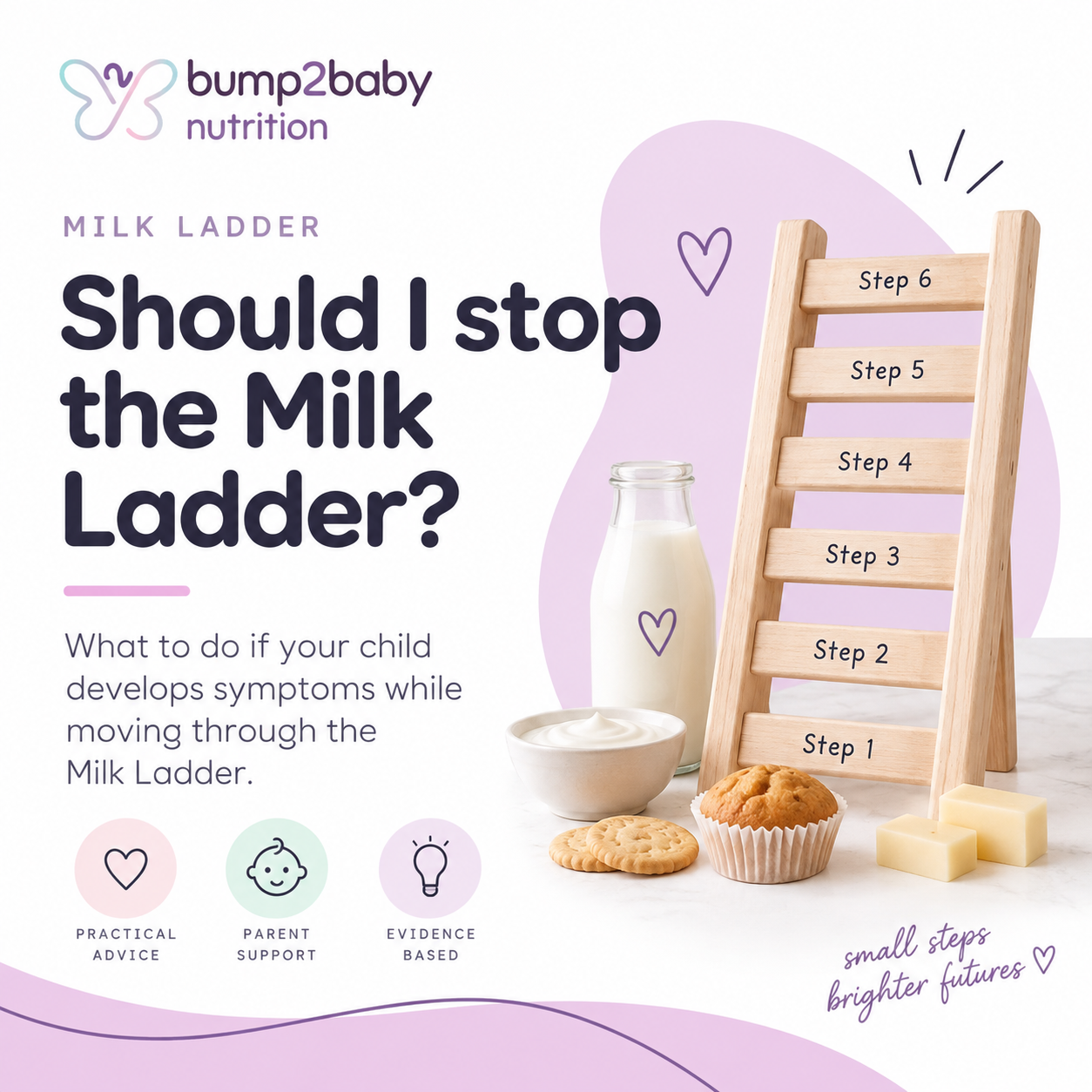
If your child develops symptoms while working through the Milk Ladder, it can be difficult to know what to do next.
Was it the milk? Were they coming down with a bug? Is their eczema just having a bad day? And should you stop the ladder completely or go back to the last step they tolerated?
These are really common questions.
The most important thing is not to push on with a new step if you think your child is reacting. In most cases, the safest next step is to stop the new food, continue with foods from any previously tolerated step if appropriate, and get individual advice if you’re unsure what the reaction means for your child.
This guide explains the symptoms to look out for, what to do if a reaction happens and when it’s important to seek further help.
If your child has previously had an immediate or severe reaction to cow’s milk, or you have not been advised that home reintroduction is appropriate, do not use this article as a guide to starting the Milk Ladder. Speak to your child’s allergy team or dietitian first.
What symptoms should I look out for on the Milk Ladder?
The symptoms to look out for are usually similar to the symptoms your child had before milk was removed from their diet.
For delayed, non-IgE cow’s milk allergy, these might include:
- changes in poo, including looser stools, mucus or constipation
- vomiting or increased reflux
- tummy pain or discomfort
- eczema or other skin changes
- coughing or congestion
- changes in feeding or appetite
One symptom on its own does not necessarily mean your child has reacted to the Milk Ladder. Babies and toddlers get tummy bugs, coughs, colds, teething symptoms and eczema flares too.
What I’d pay more attention to is a pattern — particularly if symptoms are similar to your child’s original milk allergy symptoms, start after moving up a step or increasing the amount, and happen again when the same step is tried.
If you’re finding it difficult to spot a pattern, keeping a simple record of the food, amount and symptoms can really help.
Should I stop the Milk Ladder if my child reacts?
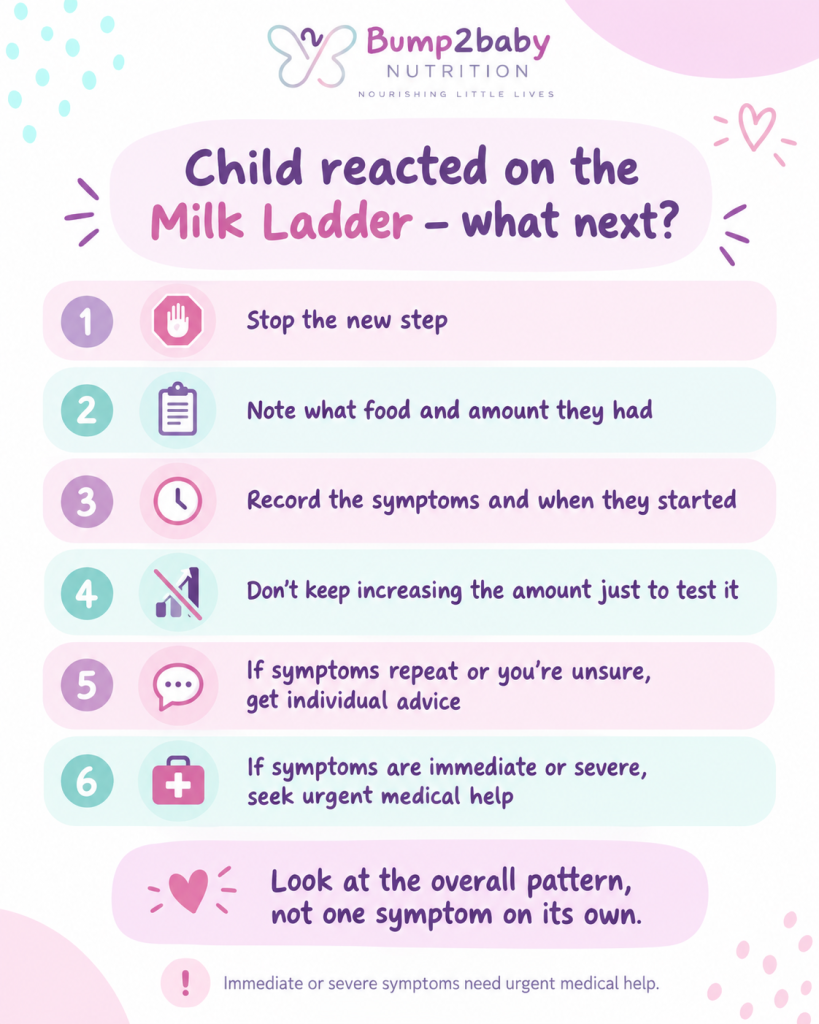
If you think your child is reacting to a new Milk Ladder step, don’t keep pushing on just to “see what happens”, unless advised by a health professional.
Stop the new food or step. If they were previously tolerating foods from a lower step, these may sometimes be continued, depending on the reaction and the advice you’ve been given.
I know this can feel really frustrating, especially if you thought things were going well and suddenly symptoms have appeared again. But a reaction does not necessarily mean the whole Milk Ladder has failed.
Sometimes it simply means your child is not ready for that next level just yet.
The important thing is to look at the reaction in context:
- What step were they on?
- How much did they eat?
- How soon did symptoms appear?
- Were the symptoms similar to their original milk allergy symptoms?
- Were they otherwise well?
- Has the same thing happened more than once?
That information can help build a clearer picture of whether the symptoms may be linked to the new Milk Ladder step or whether something else could be going on
If the symptoms are mild and delayed, it is usually sensible to stop the new step and seek advice before trying it again.
If your child has immediate symptoms such as swelling, breathing difficulty, repeated vomiting, becomes very unwell or you are worried about anaphylaxis, seek urgent medical help.
If you find yourself thinking, “I just don’t know if this is a reaction or not,” that is exactly the point where individual advice can be really helpful.
A consultation can help you look at the pattern of symptoms, the step they reached, what they were eating and whether it is appropriate to retry, pause or get further medical input.
Can I keep giving foods from the previous Milk Ladder step?
Usually, if your child was comfortably tolerating foods from a lower Milk Ladder step before the new reaction, you may be advised to keep those tolerated foods in the diet.
That can be helpful because you do not necessarily need to go all the way back to the beginning every time something changes.
For example, if your child had been managing a baked milk food well but then developed symptoms after moving onto the next step, the lower-step food they were already tolerating may still be suitable to continue.
But this depends on what the reaction looked like, how severe it was and your child’s individual allergy history.
If the reaction was immediate, significant or different from what you have seen before, get medical advice before continuing any milk-containing foods.
If symptoms were mild and delayed, keep a note of what happened and avoid pushing ahead to the next step until you are clearer on what the reaction means.
This is another reason why keeping a simple record is so useful. It helps you see exactly what was tolerated, what changed and what happened next.
And if your child seems to get stuck at the same point each time, that is when I would want to look at the whole picture with you rather than just telling you to “try again”.
What if I’m not sure whether it was milk, illness or teething?
This can be really difficult to work out.
If your child is unwell, teething or having an eczema flare at the same time as you move up the Milk Ladder, it can make symptoms much harder to interpret.
If they are clearly unwell, pause the new step until they are back to their usual baseline.
If you’re not sure what caused the symptoms, don’t keep increasing the amount just to find out. Make a note of what happened and, if the same pattern keeps repeating, get individual advice.
What if my child reacts at the same Milk Ladder step more than once?
If the same thing seems to happen every time you try the same step, that’s a sign to stop and take a closer look rather than just keep trying again.
It doesn’t necessarily mean the whole Milk Ladder has gone backwards.
Your child may simply not be ready for that next step yet, especially if they are still happily managing foods from the step below.
What I’d want to know is:
- Which step they are getting stuck on
- How much they are eating
- What symptoms you are seeing
- How soon those symptoms appear
- Whether the same thing happens every time
- Whether they are still fine with the foods they were having before
Sometimes the pattern is really obvious. Other times it is much harder to work out whether it is milk, illness, teething or something else.
If you keep ending up at the same point and thinking, “I honestly don’t know what to do next,” that’s exactly when individual advice can be really helpful.
When is a Milk Ladder reaction an emergency?
If your child develops breathing difficulties, significant swelling, repeated vomiting, becomes floppy or very unwell, or you suspect anaphylaxis, seek urgent medical help.
If your child has previously had an immediate or severe reaction to cow’s milk, the Milk Ladder should only be used if your allergy team has specifically advised that home reintroduction is appropriate.
If you’re unsure what a reaction means for your child, or they keep getting stuck at the same step, get individual advice before moving further up the ladder.

Hannah Whittaker RD is a specialist paediatric allergy dietitian with over 20 years’ experience in nutrition and 10 years as a Registered Dietitian. She specialises in food allergy in babies and children, including cow’s milk, egg, soya, wheat, peanut and tree nut allergy, food reintroduction and nutritional adequacy.
Hannah has worked in NHS paediatrics and now supports families with practical, evidence-based nutrition advice. She is also an experienced media spokesperson and has contributed to publications including The Sunday Times, The Independent and Huffington Post.
Credentials
Registered Dietitian
First Class Degree in Nutrition
Postgraduate qualification in Dietetics
Experience
Over 20 years’ experience in nutrition
10 years as a Registered Dietitian
NHS paediatric dietetics experience
Media spokesperson in the UK and internationally
Writer, committee member and researcher supporting the British Dietetic Association


