Parents often come to me with one thing that has made them worry that their baby has cows milk protein allergy.
It might be reflux.
Green poo.
Mucus.
Eczema.
Lots of crying after feeds.
And the question is usually:
“Does this mean my baby has CMPA?”
The answer is that one symptom on its own usually isn’t enough to tell us that.
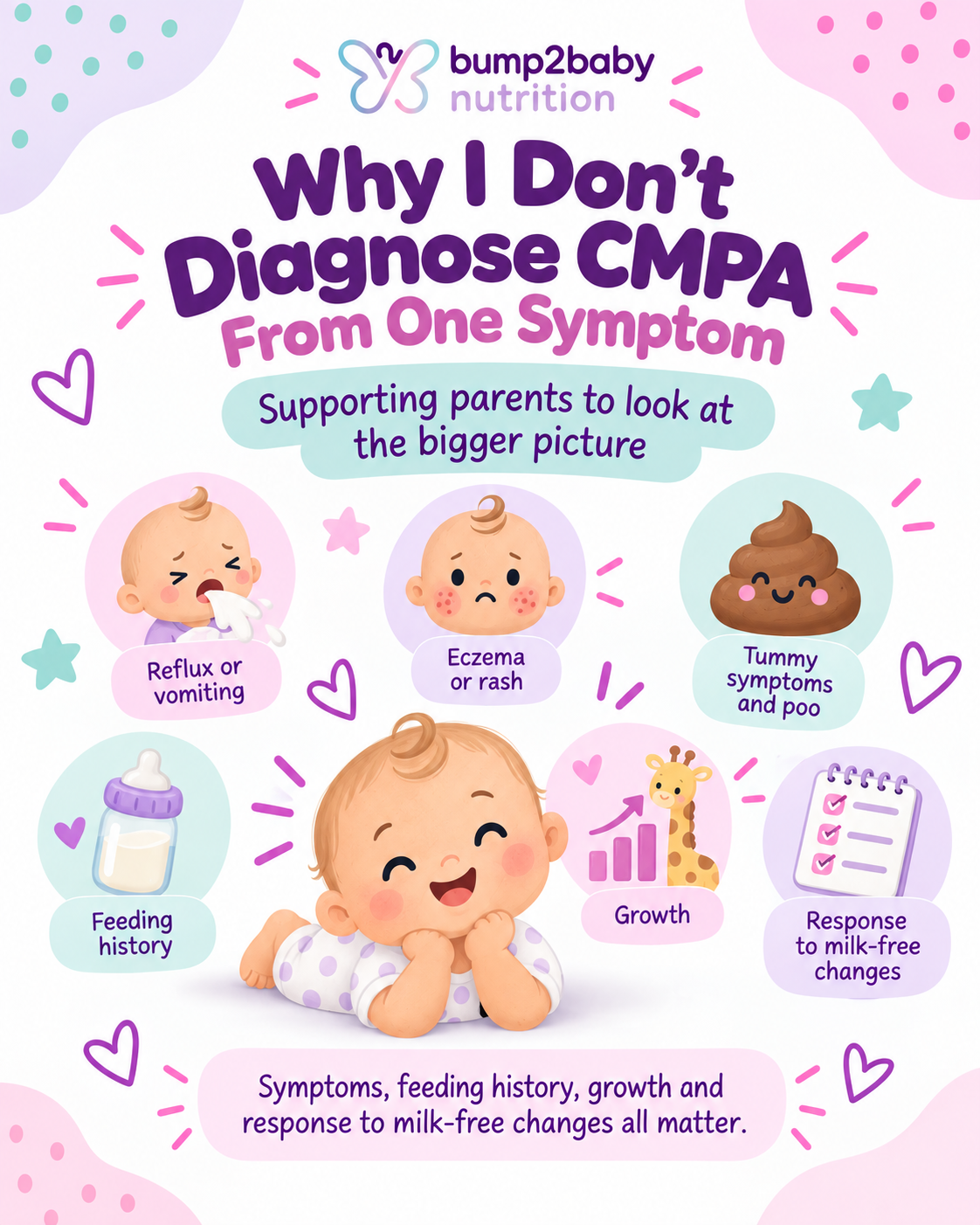
As a paediatric allergy dietitian, I can support the diagnostic process by looking at the full picture — your baby’s feeding history, symptoms, growth, timing, what has already been tried and how they respond to dietary changes.
But CMPA generally isn’t diagnosed from one symptom alone, and I wouldn’t want a parent to start removing foods or changing formula based on one symptom either.
That’s because many of the symptoms we associate with cow’s milk allergy are also really common in babies who don’t have an allergy.
Why one symptom can be misleading
Take reflux as an example.
Reflux is common in babies.
So is eczema.
So is wind.
So is loose poo.
So is crying.
Allergy UK specifically highlights that symptoms such as reflux, colic, eczema and diarrhoea are common in infancy and can have causes other than cow’s milk allergy.
That doesn’t mean we ignore them.
It just means we need to ask:
What else is going on?
That is usually much more useful than focusing on one symptom in isolation.
What I look at instead
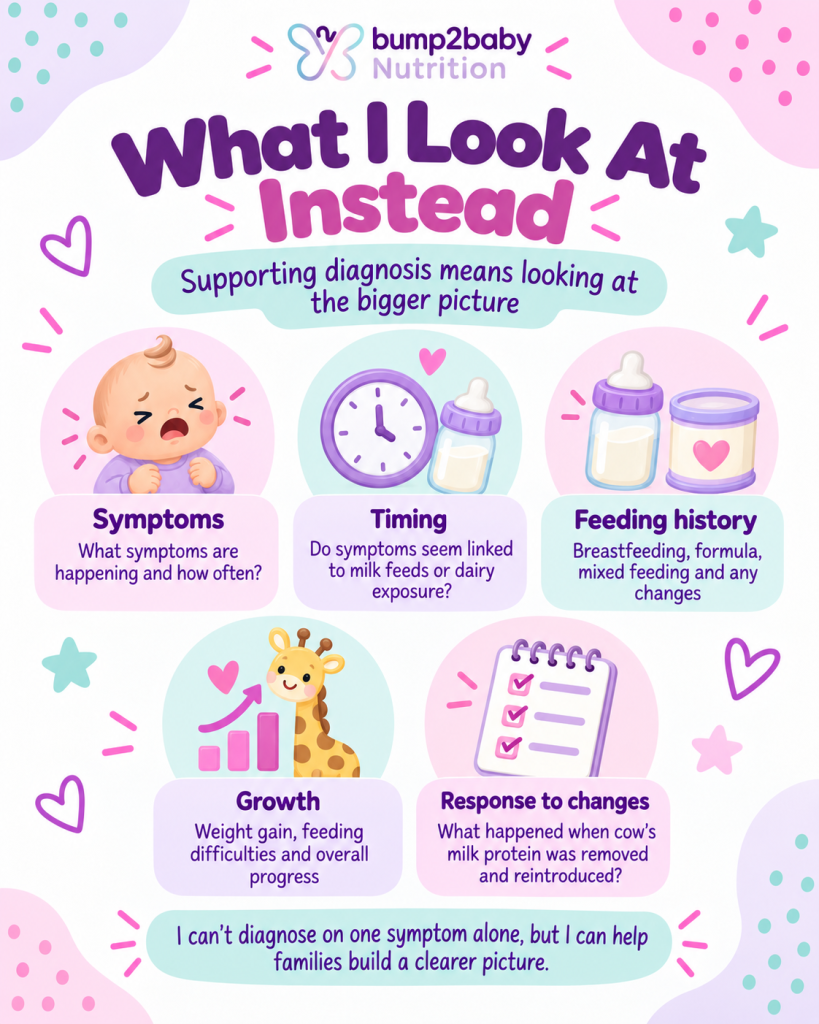
When I’m supporting a family where CMPA is suspected, I’m interested in the pattern.
I want to know things like:
- What symptoms are happening?
- How often are they happening?
- When did they start?
- Do they seem linked to milk feeds or dairy exposure?
- Is your baby breastfed, formula-fed or mixed-fed?
- Is there eczema or another allergic condition?
- Are feeds comfortable?
- Is your baby growing as expected?
- Has anything changed after removing milk protein?
- What happened when milk was reintroduced?
That gives us a much clearer picture.
A proper allergy-focused history is central to assessing suspected cow’s milk allergy, and testing or elimination depends on whether an immediate or delayed reaction is suspected.
Immediate and delayed CMPA can look very different
This is another reason why one symptom isn’t enough.
With IgE-mediated cow’s milk allergy, symptoms usually happen quickly — often within minutes and up to around two hours after milk exposure.
These can include things such as:
- Hives
- Swelling
- Vomiting
- Coughing or wheezing
- Breathing difficulty
With non-IgE-mediated CMPA, symptoms are delayed and can be much less obvious.
These might include:
- Reflux
- Vomiting
- Loose poo
- Constipation
- Blood or mucus in the poo
- Eczema
- Feeding difficulties
- Poor growth
Delayed symptoms can sometimes be harder to recognise because they may appear hours later and overlap with very common infant problems.
So if a parent says:
“My baby has reflux — is it CMPA?”
my next question isn’t simply yes or no.
It’s:
“Tell me what else is happening.”
What about allergy testing?
This depends on the type of reaction we are worried about.
If an immediate IgE-mediated reaction is suspected, skin prick testing or blood tests may be useful as part of the assessment.
For delayed non-IgE-mediated CMPA, those tests are generally not helpful.
In that situation, diagnosis is usually supported by a planned period of cow’s milk protein elimination followed by reintroduction to see whether symptoms improve and then return.
That’s why I’m cautious about parents starting a milk-free diet randomly for a few days and then deciding whether CMPA is present.
Without a clear plan, it can actually make the picture more confusing.
What I can help with as a dietitian
This is where dietetic support can be really useful.
I can help families:
- Look at the full symptom and feeding history
- Identify whether the pattern could fit CMPA
- Make sense of what has already been tried
- Support an appropriate milk-free trial where that has been advised
- Make sure breastfed mums are nutritionally supported if dairy is removed
- Help with suitable formula options where appropriate
- Monitor nutritional adequacy and growth
- Plan reintroduction where clinically appropriate
- Recognise when medical assessment or allergy testing is needed
The aim is not to remove milk “just in case”.
It is to help build a clearer picture so that the right diagnosis and management plan can be reached.
Why I don’t like “symptom spotting”
I completely understand why parents do it.
When your baby is uncomfortable, you want an answer.
You start googling:
“CMPA reflux”
“CMPA poo”
“CMPA eczema”
“Milk allergy crying after feeds”
And before long, almost every symptom seems to fit.
The problem is that symptom lists can make very common baby behaviours look diagnostic when they aren’t.
That can lead to unnecessary formula changes, restricted maternal diets or multiple foods being removed without a clear reason.
And once that happens, working out what was actually causing the symptoms can become harder.
What matters more than one symptom
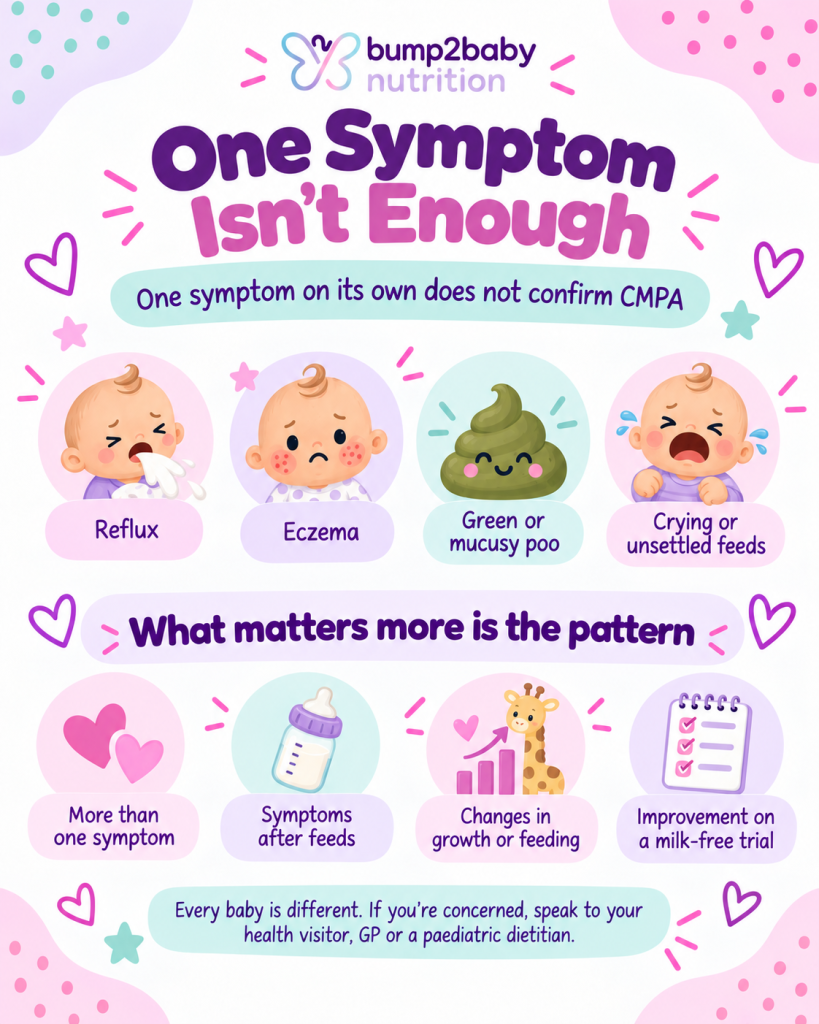
The things that matter most are:
The pattern
Are there several symptoms happening together?
The timing
Do they appear after milk exposure?
The feeding history
Breastfeeding, formula feeding and mixed feeding all give us different information.
Growth
Is your baby gaining weight and growing as expected?
Response to change
What happens when cow’s milk protein is appropriately removed and then reintroduced?
That is much closer to how I would think about suspected CMPA than simply ticking boxes on a symptom list.
When I’d want medical input quickly
Some symptoms need medical assessment rather than waiting to see what happens.
Seek urgent medical help if your baby develops:
- Breathing difficulty
- Significant swelling
- Becomes pale, floppy or very unwell
- Symptoms suggesting anaphylaxis
You should also seek medical advice if there is persistent blood in the poo, repeated vomiting, poor feeding, dehydration or concerns about growth.
Still not sure whether your baby’s symptoms fit CMPA?
This is often where parents get stuck.
You may have read a list of symptoms and thought:
“My baby has three of these.”
But that still doesn’t tell you whether CMPA is actually the cause.
Still unsure whether your baby’s symptoms fit CMPA?
I can help you look at the whole picture and support the next appropriate step.
You may also find these useful:
MILK ALLERGY VS LACTOSE INTOLERANCE IN BABIES
The main thing I want parents to know
One symptom doesn’t equal CMPA.
But one symptom also shouldn’t be dismissed if it is part of a bigger pattern.
That’s why I prefer to look at the whole baby rather than one reflux episode, one rash or one nappy.
My role is to help make sense of that pattern, support the diagnostic process and make sure any dietary changes are appropriate, safe and nutritionally adequate.
That is much more useful than trying to diagnose cow’s milk allergy from one symptom alone.
Disclaimer
The information in this article is for general education and does not replace an individual medical assessment. As a paediatric allergy dietitian, I can support the assessment and management of suspected cow’s milk protein allergy, but a diagnosis should be made as part of the wider healthcare team, usually with your GP, paediatrician or allergy specialist where appropriate.
If you are concerned about your baby’s symptoms, speak to a healthcare professional. If your baby develops breathing difficulties, significant swelling, becomes pale or floppy, or you suspect a severe allergic reaction, call 999.
*

Hannah Whittaker RD is a specialist paediatric allergy dietitian with over 20 years’ experience in nutrition and 10 years as a Registered Dietitian. She specialises in food allergy in babies and children, including cow’s milk, egg, soya, wheat, peanut and tree nut allergy, food reintroduction and nutritional adequacy.
Hannah has worked in NHS paediatrics and now supports families with practical, evidence-based nutrition advice. She is also an experienced media spokesperson and has contributed to publications including The Sunday Times, The Independent and Huffington Post.
Credentials
Registered Dietitian
First Class Degree in Nutrition
Postgraduate qualification in Dietetics
Experience
Over 20 years’ experience in nutrition
10 years as a Registered Dietitian
NHS paediatric dietetics experience
Media spokesperson in the UK and internationally
Writer, committee member and researcher supporting the British Dietetic Association